
Which La Mesa Records Are Open
La Mesa records follow the office that made or received them. The city handles its own permits, code material, contracts, correspondence, and police-report requests. San Diego County offices keep the main land, assessment, court, and vital-record systems. State agencies add professional licenses, business filings, prison custody records, and other statewide indexes. An online index is not the same as an open document. It may show only enough detail to identify a filing before a copy is ordered.
| La Mesa record set | Official keeper | Online coverage | Access route |
|---|---|---|---|
| Deeds, liens, recorded notices | San Diego County Recorder | Official Records Index, 1970 to present | Index online; copies by portal, mail, or counter |
| Assessment and parcel records | San Diego County Assessor | Current roll and GIS tools | ParcelQuest, phone, or office kiosk |
| Civil, criminal, family, and probate cases | San Diego Superior Court | Current index with case-type limits | Index, Register of Actions, copy order, or courthouse |
| Birth, death, and marriage certificates | County ARCC and CDPH | Certificate request system | Authorized or informational copy rules |
| City permits, correspondence, and reports | City of La Mesa | Released requests and city tools | NextRequest, department form, or city counter |
| Custody and offender information | Sheriff, CDCR, and California DOJ | Current public lookup data | Official lookup subject to use limits |
California law still closes or limits many details. Juvenile and sealed court matters, adoption records, confidential marriage records, motor-vehicle data, protected addresses, parts of police investigations, and sensitive voter data do not become open merely because they concern a public agency. The correct access status depends on the record, not on a broad label.
- Index
- A list of record facts, such as names, dates, document type, and filing number. It may not include the image.
- Certified copy
- An official copy authenticated by the custodian. Eligibility and added fees may apply.
- Custodian
- The office responsible for keeping and releasing a particular record.
- Exemption
- A legal reason that permits or requires an office to withhold all or part of a record.
La Mesa Recorder Index Coverage
The San Diego County ARCC Official Records Search is the main index for deeds, liens, releases, maps, and other recorded documents tied to La Mesa property. ARCC Owner Alert dates the searchable online index from 1970 to the present. Older record books require archive, library, or in-person research. The index can establish that a document exists, identify its parties, and supply the recording number needed for a copy order.
| Recorder search field | Use | Availability note |
|---|---|---|
| Name or party | Search grantors, grantees, and other indexed parties | Optional; ARCC warns not every name is indexed |
| Document number | Retrieve a known recording | Best when copied from a deed or earlier result |
| Recording date range | Narrow a common name | Optional date pair |
| Document type | Limit results to deeds, liens, notices, or maps | Optional filter |
| APN | Parcel-based official-record search | Unavailable online; kiosk only |
A result may list party names, document type, recording date, and document or book-page number. Copies move through the portal cart, by mail, or at an ARCC counter. Not every name or assessor parcel number appears in the index, so a blank result is not proof that no deed exists.
The county explains the online parcel-search change on its recording rules page.
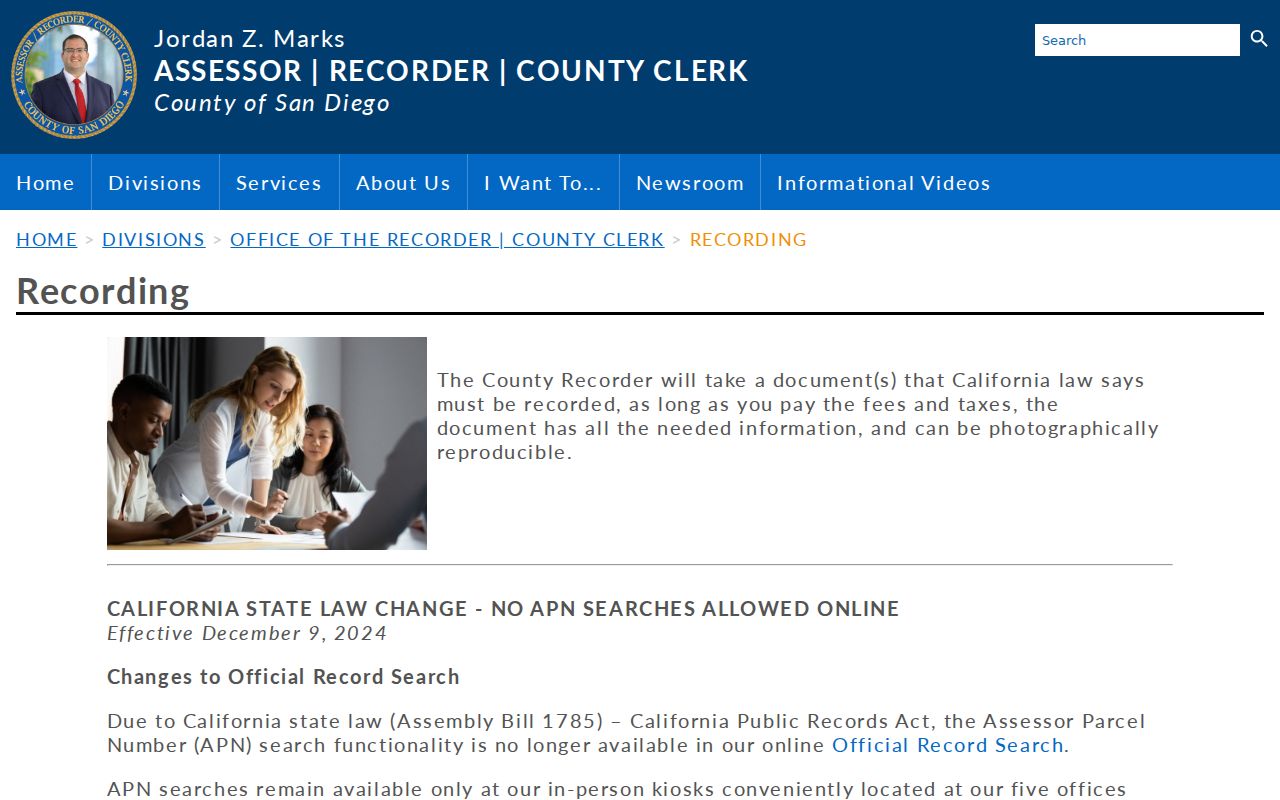
The captured page gives the official route to the recorder index and the current limit on parcel-number searching.
Note: The index begins in 1970; early San Diego County recorder deeds may instead appear in archival collections covering 1850 through 1916.
La Mesa APN Records Changed
Effective December 9, 2024, ARCC removed assessor parcel number, or APN, searching from the online Official Records Search because of a California law change. APN searches remain available at in-person kiosks in five county offices. Online users must instead search recorded documents by a person's name, date, document number, or type after using a parcel source to identify the owner and property facts.
Insider tip. Keep the APN for the assessor and GIS systems, then use the owner's name and a narrow date range in the recorder index. Visit an ARCC kiosk when only the parcel number is known.
This split is easy to miss. APN search still works in assessor and GIS tools; only the recorder's public web index lost that search path. A deed may contain an APN even though the website no longer accepts it as a query.
La Mesa Property Records Channels
Property access spans three systems. SanGIS and SANDAG map tools accept an address, APN, or intersection and return parcel context. The assessor supplies ownership, mailing-address, parcel-map, and assessment information. The recorder then holds the deeds and liens. The ARCC Property Information page lists the Public Information Line at 619-236-3771 and public computer kiosks as direct access channels.
The official ParcelQuest notice says users may conduct 25 searches in any 30-day period without charge. It also makes clear that the user leaves the county site for the vendor service.
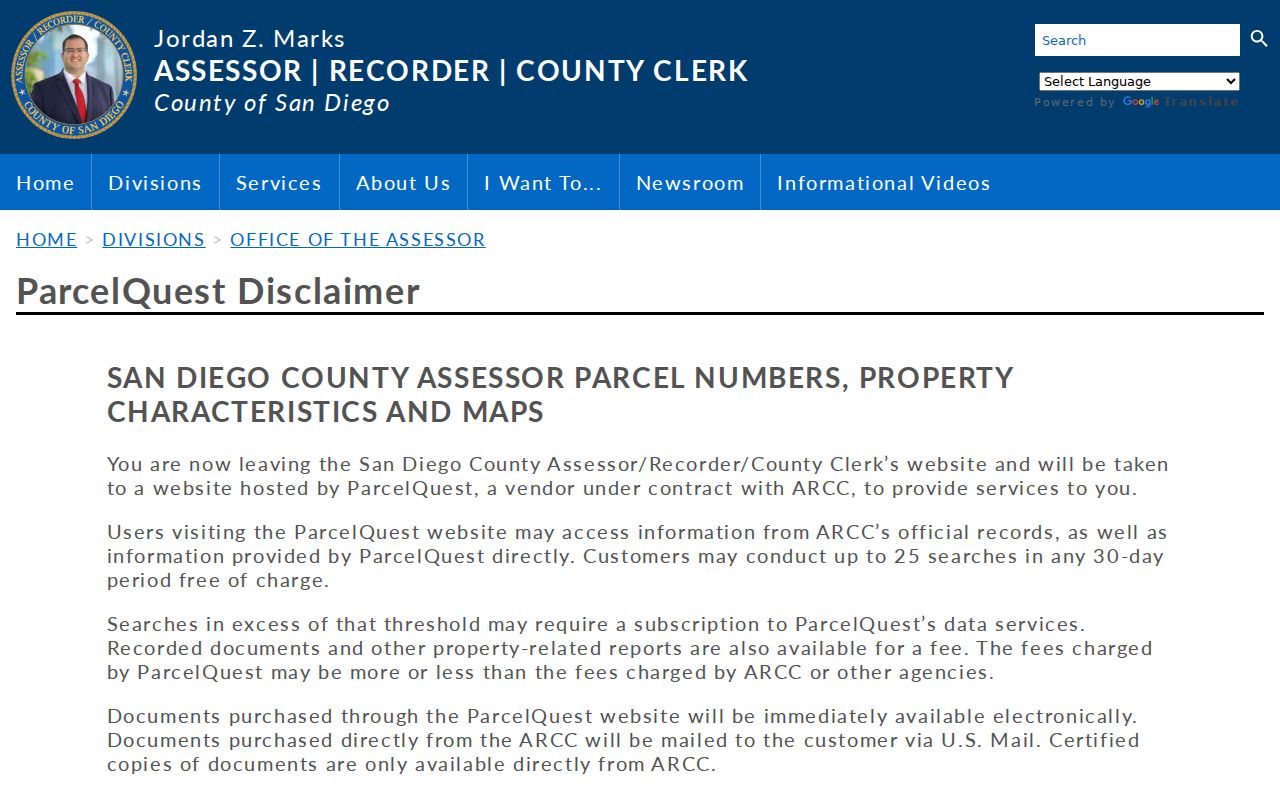
The notice distinguishes the assessor's official records from added vendor data and explains the free-use limit.
The situs address is the parcel's physical location. The mailing address is where assessment notices go, and it can differ. For current owner contact research, that mailing field is often more useful. Confirm jurisdiction too: a La Mesa postal address may fall outside city limits, placing permits and code records with another local agency.
La Mesa Court Records Access
La Mesa court files run through the San Diego Superior Court records hub, not a city court. The Court Index searches civil, criminal, family, mental health, and probate cases by party, case number, or District Attorney case number. The separate Register of Actions is the docket, meaning the dated list of hearings, filings, orders, and other case events.
The party-name search requires a last name and permits first name, middle name, case type, and party type filters. Civil limited and misdemeanor results may reach back only ten years at some court locations. Juvenile cases and infractions are excluded. Older information may be on courthouse microfilm, and court staff do not conduct that research.
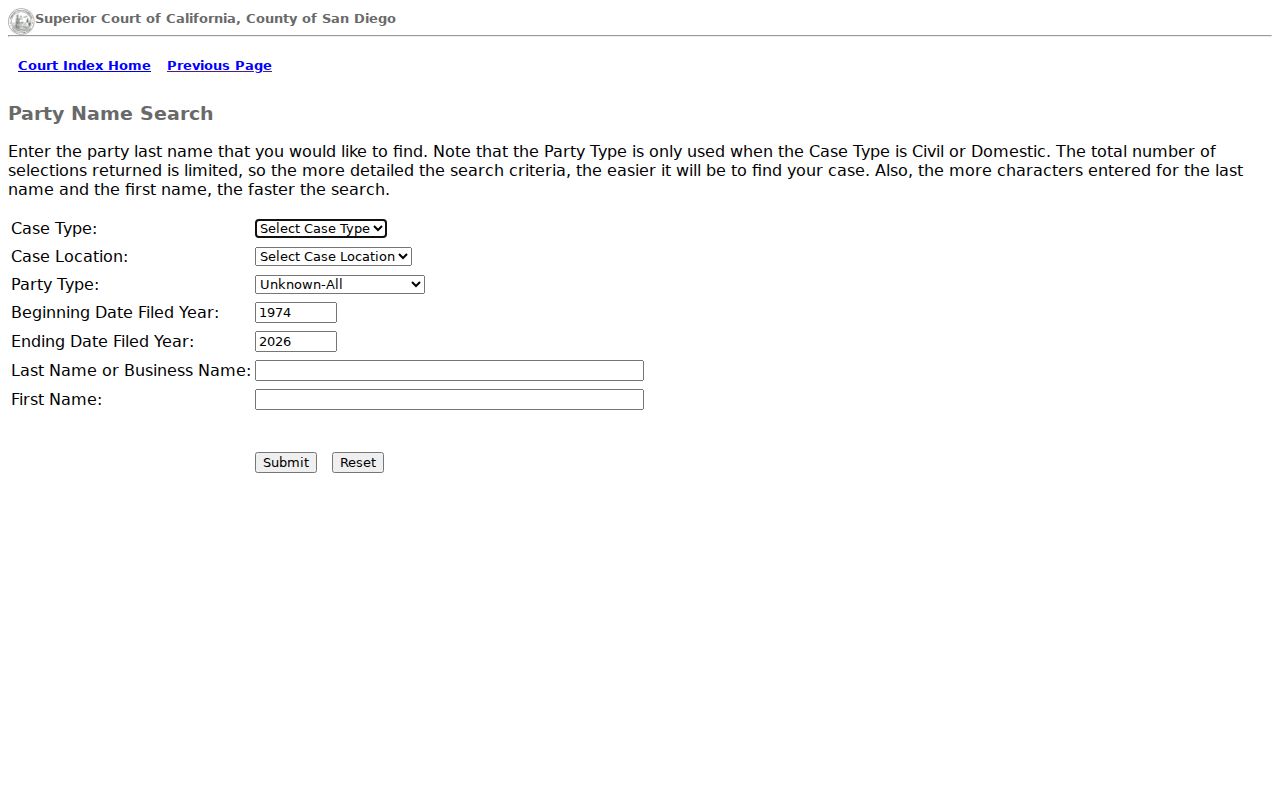
The form shows why a middle initial and case-type filter can separate people who share a common name.
Most civil, small-claims, and probate files permit a first-page preview and paid download where documents are available. Criminal documents cannot be viewed or downloaded online; copies are purchased and mailed. Hard-copy files must be requested from the courthouse holding them. A non-party search lasting more than ten minutes can trigger the search fee authorized by Government Code § 70627(c).
Note: The index identifies the courthouse holding a file; use that location, not the searcher's home city, for hard-copy requests.
La Mesa Vital Records Boundaries
San Diego County ARCC processes birth and death certificates for events in the county and marriage certificates when San Diego County issued the license. The county certificate page asks applicants to wait three weeks after the event. If no matching record is found, ARCC issues a Letter of No Record and keeps the processing fee.
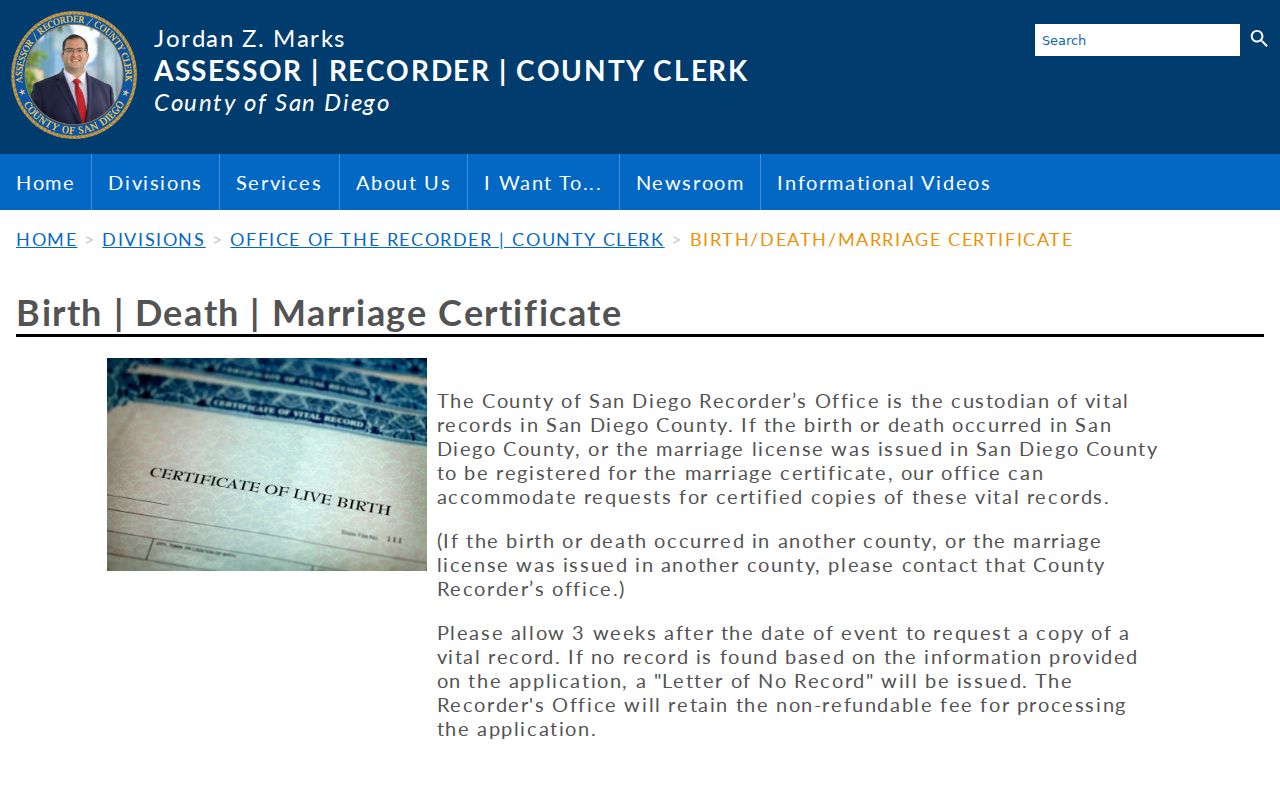
The county page separates certificate types and routes requests according to where the event or marriage license was recorded.
California Health and Safety Code §§ 103525 and 103526 create the key split. An authorized certified copy is limited to listed relatives, the registrant, specified representatives, and other eligible requesters, with a sworn statement. Others may obtain an informational certified copy marked as invalid for identity. Confidential marriage certificates are narrower still. Divorce belongs with San Diego Superior Court, not ARCC.
Eligibility warning. Calling a certificate a public record does not make an unrestricted identity copy available. Select the proper copy type and verify the current fee before ordering.
La Mesa Police Records Contact
La Mesa Police Department reviews report requests case by case. The city's police records page says reports tied to open court cases are unavailable until the case is fully adjudicated. A Report Copy Request form starts the process. Most non-traffic reports are processed within ten working days, while collision reports may take up to thirty days for the investigating officer to complete.
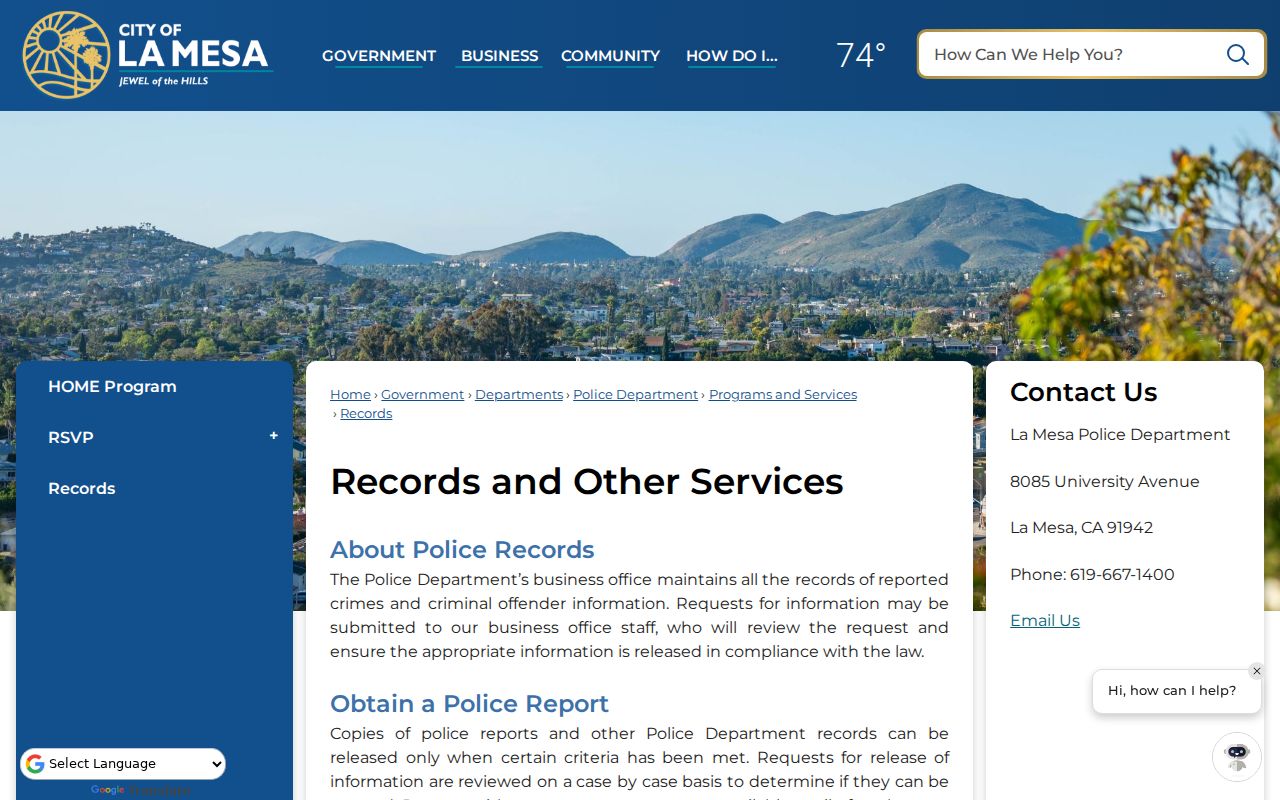
The city page reinforces that a police report is a controlled request, not an open name index.
The California DOJ listing provides a more direct records contact than the general City Hall line: La Mesa Police Department, 8085 University Avenue, La Mesa, CA 91942; 619-667-7592; pdrecords@cityoflamesa.us. Its listed appointment hours are Wednesday and Thursday, 9:00 a.m. to 4:30 p.m. That contact can clarify whether a report is ready and whether the requester meets release criteria.
Note: Collision reports can take longer because the investigating officer may need up to thirty days to complete the report.
La Mesa Records Offices and Portals
Each custodian has a distinct role. City Hall receives municipal requests. ARCC combines recorder, clerk, assessor, and local certificate functions. The Superior Court controls its case files. Start with the office that created the record, then use its online index, mail procedure, phone line, or counter.
San Diego County ARCC
Recorder, County Clerk, Assessor, and vital-record services
619-236-3771 assessor line
San Diego Superior Court
East County matters commonly route through the El Cajon courthouse
Use the case index to confirm the file location
La Mesa City Hall is open Monday through Thursday from 7:30 a.m. to 5:30 p.m. and Friday from 7:30 a.m. to 4:30 p.m., with closure on alternate Fridays. Check the custodian's current schedule before an in-person trip.
La Mesa Records Are Not All Online
Online access has firm edges. Recorder materials before 1970 move to archives and historical collections. Older court cases may require microfilm at the courthouse. Assessor ownership remains available by phone and kiosk even if the vendor search is not suitable. Certified certificates require an application, proof of eligibility when applicable, and payment. City police files require release review.
The San Diego County Clerk of the Board is an unusual exception: its document management system searches Board actions from 1877 to today, including digitized archived microfilm. The recorder web index starts in 1970, while court staff will not research older microfilm for a requester. These different cutoffs make the fallback channel as important as the portal.
Closed and restricted material includes juvenile or sealed cases, adoption files, confidential marriages, protected addresses, motor-vehicle data, sensitive voter fields, and parts of active police matters. A California Public Records Act request cannot override a specific confidentiality law.
Note: California's Safe at Home program can place a substitute mailing address in records for eligible participants, so an address may be intentionally protected.
Requesting La Mesa Public Records
Any person may request disclosable agency records under the California Public Records Act, Government Code §§ 7920.000 through 7931.000. Government Code § 7922.535 generally gives the agency ten days to determine whether it holds responsive, disclosable records and to notify the requester of its decision and reasons. Unusual circumstances can support an extension. That determination deadline is not a promise that every copy will arrive in ten days.
- Identify the custodian. Send city permits and correspondence to La Mesa, deeds to ARCC, and case files to the court.
- Check the purpose-built index and already released requests first. Record any case, permit, parcel, or document number.
- Describe a defined record set. Give date ranges, department names, addresses, subject names, and known identifiers.
- Ask for electronic copies when useful and confirm duplication, certification, or statutory fees before work begins.
- If the office cites an exemption, ask which portion is withheld and whether a redacted copy or narrower request can be released.
La Mesa uses NextRequest to search released records, submit a new request, track its status, and retrieve available files. A focused request reduces delay. Agencies generally may recover direct duplication costs or a fee set by law, but not impose a broad research charge unless a statute permits it.
Lawful use. Use La Mesa public records for legitimate personal research and civic review. Never use names, addresses, court details, or registry data to stalk, harass, threaten, or harm anyone.
La Mesa Records Fees and Copies
Fees depend on both the record and the product. A free index can lead to a paid image, paper copy, or certified copy. ParcelQuest allows 25 free searches in thirty days. Court document downloads and copy orders may carry charges, and a non-party courthouse search taking over ten minutes can carry a statutory search fee. Vital-record fees are nonrefundable when a valid search produces a Letter of No Record.
San Diego County fictitious business name records provide a useful fee example. Filing costs $54 for the first business name and registrant, plus $5 for each added name or registrant. Copies cost $2 for the first page and $0.05 for each added page, with $1 certification. A staff search by mail costs $8 and needs the exact business name and, when known, the registrant name. Recorder, court, and certificate schedules differ, so verify the current amount with the custodian before sending payment.
A plain index result may be enough to locate a filing. Use a certified copy only when an official authenticated record is required. Choosing the smallest useful product keeps a La Mesa records request focused and avoids paying for material that does not answer the question.